



Title: Human Systems Science In the Best Interest of the Child’s Mental Health and Self-Awareness
Featuring Dr. Slaton Live™ The Brain Talker The New Frontier in Brain Talk Talk to the Child’s Brain, Not the Child’s Body. The Brain Does That!
Your Body wears trained states of Mind. Your Brain wears the Body, which reveals the process states of your emotions. As energy, actions, and feelings traverse your Brain and Body interaction, your senses transfer signals. This is because when the Body reacts, your Brain must send forward feed from where you are in the Crisis of Self.
The applied use of systems thinking led to human systems science as the study of the brain, body, and sense events. Hence, the applied use of human science led to the study of human, cognitive, and behavioral sciences. As a practitioner of human systems science, Christopher Slaton’s interest has always focused on the study of human contact, human cognition, and human behavior.
Human Systems Science fosters a child’s capacity to learn who they are. This book aims to advance brain learning and the neurophysics of self by exploring the complex dance between a child’s mental health and brain, body, and sense messaging. Dr. Slaton decodes ways to foster a child’s capacity to learn who they are within the context of self-research, self-help, and self-discovery in this volume of a new frontier of brain talk.
Read an excerpt Order a copy now
Education and Science
The Brain’s Body Help to Improve Brain, Body, and Sense Events
Education and Science: The Brain’s Body Help to Improve Brain, Body, and Sense Events is one of those self-improvement books that help readers understand how action research can lead to a more integrated and advanced life. Paraphrasing Wikipedia, action research is a method of transformative change while simultaneously acting and doing research. This self-improvement book guides readers through the benefits of action research to help them live more effectively as they decide how to respond to different circumstances. The author provides examples of action research and elaborates on how human-centered systems thinking can impact the neurological operation of the brain. It might be one of the best books about self-improvement that connects several interrelated elements that affect our lives, including self-examination, studying those around us, the environment, and our sense of being or Self. In the book, he connects these interrelated elements and their impact on our behaviors to help readers overcome hurt and pain.
Read an excerpt Order a copy now
Education and Science in the Best Interest of the Child
A Human Systems Research Investigation for Addressing Children Who Come from a Family Suffering from Substance Abuse
We have confirmed through our October 11, 2016, building human assets meeting with the California Department of Education that there is no federal or state policy in place to address the eligibility status of children from a family history of suffering from substance abuse–related disorders. Hence, the Building Human Assets Project Human Systems Research in Education study is in an area not covered by federal or state laws or regulations. This is why a new scientific approach is needed in the best interest of the child.
To the benefit of all children, the Individuals with Disabilities Act was reauthorized and signed into law on December 3, 2004 as the Individuals with Disabilities Education Improvement Act of 2004, Public Law 108-446. This includes several requirements effective July 1, 2005, which calls for states to establish “policies and regulations that require referral for early intervention services of a child under the age of three who is identified as affected by illegal substance abuse or withdrawal symptoms resulting from parental drug exposure” (Section 637[a][6][B]). This relates to the anatomy of the child suspected of suffering from a family history of substance abuse–related disorders
The Keeping Children and Families Safe Act of 2003 was intended to add new requirements under the Child Abuse Prevention and Treatment Act of 2004, to include the requirement that states have policies and procedures in place which require health care providers to notify Child Protective Services of infants born and identified as being affected by illegal substance abuse or withdrawal symptoms that result from prenatal drug exposure. Hence, the educational implications for children inflicted with disorders as a result of exposure to drugs in the utero. Early intervention and treatment is a basic need.
The 2015 Every Student Succeeds Act (ESSA) shifts federal accountability provisions to the states. ESSA is the law that governs the United States K-12 public education policy, and replaces the No Child Left Behind Act through the reauthorization of the 1965 elementary and secondary education Act (ESEA). ESEA established the American federal governments expanded role in funding education in the best interest of the child. This is the sense through which the words the family community engagement reflects on the compelling needs of the child, the family, and the community.
Read an excerpt Order a copy now
Education and Science
Save Our Youth
2011-2012 SOY Pilot Merced Building Human Assets Project
Building Human Assets Meetings
Youth Leadership and Workforce Development
Parent Education and Resource Coordination Services
Crisis Management Conferences for Males
Human Systems Science Seminars for Educators
Mentoring Services
Community-Based Learning
►► Learning how to Live in a Home
►► Learning how to Learn in a School
►► Learning how to Think in a Neighborhood
►► Learning how to Respond in a Workplace
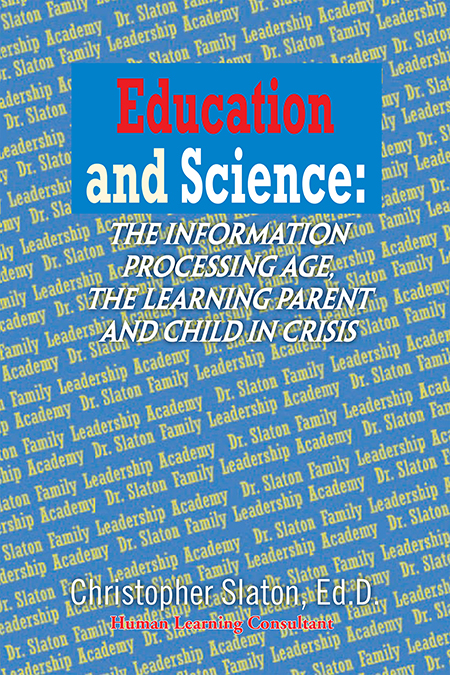
Education and Science: the Information Processing Age, the Learning Parent and Child in Crisis
The Information Processing Age, the Learning Parent and Child in Crisis
The Problem:
Too many children are growing up hurt. This means they are more likely to enter school with a behavior that affects his or her sense and receive paths. A child’s lack of openness to contact in school will influence the way they interact with reading, writing, and mathematics. Dr. Slaton’s concerns are with the behavior that leads to learning problems in school, which in turn affect the parent and child bond. Hence, many children that enter school hurt are more prone to dropping out or performing poorly because they have not been set up for social and academic interaction.
The Answer:
Learn how to talk to the child’s brain. Human systems research has moved us to study how the parent and child live, learn, think, and respond to signs of care. Basic sense and receive paths are used to process signs of care, which move the parent and child’s feeling of us to their brain. We have to prepare more helpers. The caring process involves how parents parent, teachers teach, children learn, and helper help. Together, we have to test and assess the way we use talk as a sign of care to work with a child that has been identified as hurt, and a parent that has been identified as being in crisis; brain, body, and senses.
Read an excerpt Order a copy now
Education and Science
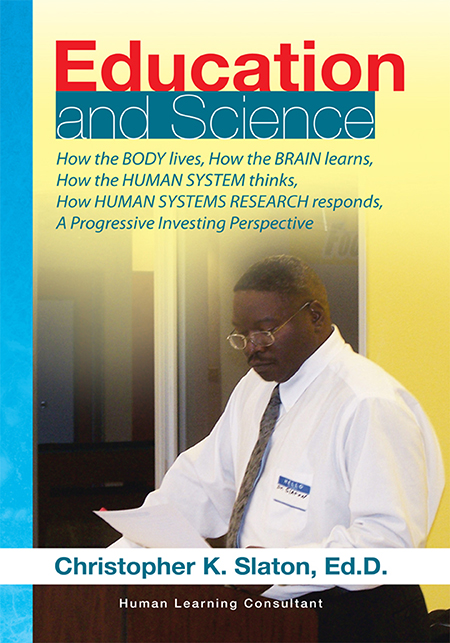
How the BODY lives, How the BRAIN learns, How the HUMAN SYSTEM thinks, How HUMAN SYSTEMS RESEARCH responds, A Progressive Investing Perspective
Let’s talk about education and science:
1. How does the body learn to live?
2. How does the brain learn to learn?
3. How does the human system learn to think?
4. How does human systems research respond?
5. What is a progressive investing perspective?
Learn how children, youths, and young adults that have been hurt by major life events in their home, school, neighborhood, or workplace network live, learn, think, and respond.
